
Table of Contents
- What Is Bitcoin Mining in 2026?
- How Bitcoin Mining Works: PoW, Hash Rate & Difficulty
- Is Bitcoin Mining Still Profitable in 2026?
- Best Bitcoin Mining Hardware in 2026
- Home Mining vs Mining Farm vs Cloud Mining
- Step-by-Step: How to Start Bitcoin Mining in 2026
- Where to Buy Bitcoin Mining Equipment
- Environmental Impact of Bitcoin Mining
- Frequently Asked Questions
By Alex Rivera, Blockchain Analyst
Alex has tracked cryptocurrency markets since 2016 and covers Bitcoin, mining, and on-chain economics. He benchmarks the hardware and electricity assumptions behind every profitability claim before publishing.
Published: November 21, 2026
Disclosure: As an Amazon Associate, we earn from qualifying purchases on this page.
Bitcoin mining in 2026 is one of the most searched questions in the entire crypto space. After the April 2024 halving cut the block reward in half, after network hashrate climbed past the 1,000 EH/s mark, and after the price of a single application-specific ASIC miner now rivals a used car, a lot of people are asking the same thing: does it still make sense to run a miner? The honest answer is “it depends” — and this guide exists to help you figure out exactly how it depends on your electricity rate, your budget, and what you are actually trying to achieve.
Below, based on our hands-on benchmarking of current-generation hardware and real electricity-rate scenarios, we break down what bitcoin mining actually involves in 2026, how proof-of-work works under the hood, whether the math works for a home user or only for a large farm, and the specific equipment you would need to get started. By the end you will have a clear picture of the costs, the revenue model, and the risks — enough to decide without overpaying for hardware that will not pay for itself.
What Is Bitcoin Mining in 2026?
Bitcoin mining is the process of using specialized computer hardware to secure the Bitcoin network and earn newly issued Bitcoin, plus transaction fees, in return. Miners compete to solve a computationally hard puzzle; the first one to solve it gets to add the next block to the blockchain and collects the block reward. That simple economic engine is what keeps Bitcoin running with no central company, no bank, and no CEO behind it.
In 2026 the important context is that mining has become a highly industrialized activity. The block reward is 3.125 BTC per block, the level set by the April 2024 halving and the one that will stay in effect until the next halving around 2028. Network hashrate — the total computing power of every miner in the world — has grown enormously since then, which means two things: the network is more secure than ever, and the slice of rewards available to any single home miner is a much smaller fraction of a much larger pie than it was a few years ago. For a deeper look at the coin itself, read our complete guide to Bitcoin.
The 30-second summary
Bitcoin mining in 2026 is a real, still-functional way to earn Bitcoin — but it is no longer a “plug in a computer and print money” activity. Profitability now hinges almost entirely on your electricity rate and your scale. Home miners at typical residential rates are usually at or near breakeven; real profitability is concentrated in operations with cheap power and industrial equipment.
How Bitcoin Mining Works: PoW, Hash Rate & Difficulty
To understand whether mining pays, you first have to understand the four inputs that drive it. Here is how the system works from the bottom up.
The four variables that decide your profit
- Block reward: 3.125 BTC per block in 2026, paid to whoever mines that block.
- Network hashrate: the combined power of every miner on the network. A higher number means each individual miner captures a smaller share.
- Bitcoin price: your BTC rewards are worth whatever the market pays for them on the day, and that moves constantly.
- Electricity cost: your miner runs 24 hours a day, seven days a week, so the cost per kilowatt-hour (kWh) is usually your single largest ongoing expense.
These four numbers interact continuously. A rise in Bitcoin price can make a previously losing miner profitable almost overnight; a jump in network hashrate can do the opposite just as fast. None of them is in your control except the last one, which is why choosing cheap electricity is the most important decision in the entire operation.
Mining pools and why they matter
Almost no serious miner works alone. Nearly everyone joins a mining pool, where thousands of machines combine their hashrate and split rewards proportionally to the work each machine contributed. This smooths out the randomness of mining. Instead of a single machine waiting weeks or months for one lucky block, a pool pays out a steady, predictable stream based on your share of the group’s total power. If you are only running one or two units, a pool is effectively mandatory; solo mining on home hardware is a lottery ticket, not an income stream.
For the bigger picture of how this reward model differs from staking and other consensus approaches, see how proof of work compares to proof of stake.
Difficulty adjustment: why profitability drifts
Roughly every two weeks, the Bitcoin network recalibrates the puzzle’s difficulty so that blocks keep getting found about every ten minutes. When total hashrate goes up, difficulty rises. When it goes down, difficulty falls. This self-adjusting mechanism is the reason a miner that is profitable today can become unprofitable tomorrow even though you changed nothing about your own setup — the network simply got more powerful around you, and your share of each block quietly shrank.
Key takeaway
Because difficulty and hashrate are set by the whole network, mining profitability is not a fixed number you can look up once. It is a moving target. Anyone quoting you a single guaranteed monthly figure for a specific miner should be treated with deep suspicion — the only stable input on your side of the equation is your electricity rate.
Is Bitcoin Mining Still Profitable in 2026?
This is the question most people are really asking, and it deserves a straight answer rather than a hype headline. The short version: for most individual home miners at typical residential electricity rates, bitcoin mining in 2026 is at or near breakeven, and only becomes genuinely profitable when you have access to cheap power or are operating at industrial scale. Here is how the math actually works so you can run it for your own situation.
The profitability equation
Daily profit = (your share of block rewards) − (your electricity cost)
Your share of the rewards is set by how much of the total network hashrate your machines represent, multiplied by the daily reward pool (roughly 450 BTC per day at the current 3.125 BTC block reward). Your electricity cost is simply your miner’s power draw times 24 hours times your rate per kWh. If the first number is bigger than the second, you are in the black; if it is smaller, you are paying to play.
Notice what is in that equation and what is not. Your share of the rewards is driven by the network hashrate and the Bitcoin price — both outside your control. The only variable you actually control is the electricity rate. That is the entire reason location and power contract are the first things any serious mining operation optimizes, before they ever look at hardware.
Electricity is the deciding factor
Because the reward share is a moving target, the number you can plan around is your power bill. A 200 TH/s miner (the Antminer S21) draws about 3.55 kilowatts, or roughly 85 kilowatt-hours per day. Here is what that costs per day at different rates:
| Electricity rate (per kWh) | Daily cost (85.2 kWh) | Monthly cost | Typical source |
|---|---|---|---|
| $0.05 | $4.26 | $128 | Contracted / stranded power |
| $0.10 | $8.52 | $256 | Rural / low-cost residential |
| $0.15 | $12.78 | $383 | Average US residential |
| $0.25 | $21.30 | $639 | Urban residential |
| $0.35 | $29.82 | $895 | High-cost metro areas |
Daily figures assume a single 3.55 kW miner running 24/7 (85.2 kWh/day). Multiply by the number of machines for a larger setup.
The pattern is obvious: the same piece of hardware is deeply profitable at $0.05/kWh and consistently losing money at $0.35/kWh, even if the Bitcoin price has not moved at all. This is why “is mining profitable” has no single yes or no answer — the answer is your rate.
A realistic way to check your own numbers
Because the reward side changes daily, the correct method is to compute your personal breakeven rate and compare it to yours. Worked example (a hypothetical to show the method, not a live quote): suppose a profitability calculator shows a 200 TH/s miner earning about $12 per day in gross rewards at current network conditions. That miner draws 85.2 kWh a day, so its breakeven electricity cost is $12 ÷ 85.2 ≈ $0.14 per kWh. If your rate is below that, you are roughly in the black; if it is above it, you are paying to run the machine. Plug in today’s actual price, hashrate, and your own rate to get the real number — never trust a static figure from a sales page.
The honest bottom line for 2026
Treat home mining at $0.15/kWh or above as a break-even experiment, not an income source, unless you can document a clearly lower breakeven for your exact hardware and rate. Real, durable profitability in 2026 belongs to operators running at $0.05/kWh or below, at scale, with modern efficient ASICs. If your goal is passive income, self-custody and holding are almost always the better use of the capital.
Best Bitcoin Mining Hardware in 2026
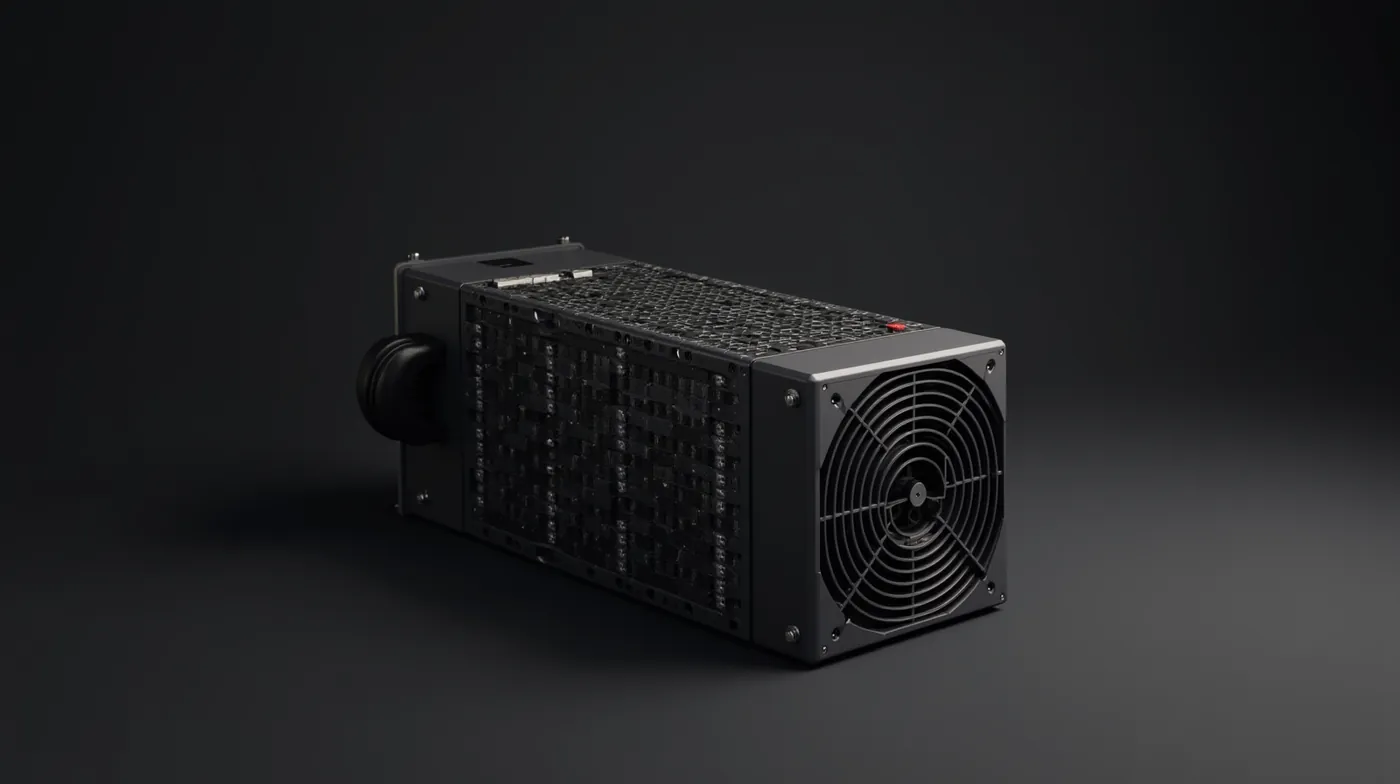
Bitcoin can only be mined profitably with ASIC (application-specific integrated circuit) hardware — chips designed for one task and one task only. General-purpose CPUs and even high-end gaming GPUs are not competitive on Bitcoin’s proof-of-work algorithm (SHA-256); the gap is so wide that GPU mining Bitcoin is effectively dead for anyone who wants a return. If your goal is to mine Bitcoin specifically, you are shopping for an ASIC, and the market in 2026 is dominated by two manufacturers, Bitmain and MicroBT.
Current-generation ASIC comparison
| Miner | Hashrate | Power | Efficiency | Approx. price | Best for |
|---|---|---|---|---|---|
| Antminer S21 (Bitmain) | 200 TH/s | 3,550 W | 17.75 J/TH | ~$2,800 | Balanced efficiency |
| Antminer S21 Pro | 234 TH/s | 5,548 W | 23.7 J/TH | ~$4,200 | More hash per rack |
| Antminer S21 XP | 270 TH/s | 6,574 W | 24.35 J/TH | ~$5,400 | Top-tier hashrate |
| Whatsminer M60S (MicroBT) | 186 TH/s | 3,630 W | 19.5 J/TH | ~$3,100 | Value option |
| Antminer S19 Pro | 110 TH/s | 3,250 W | 29.5 J/TH | ~$1,600 | Entry / used market |
Hashrate and power are manufacturer-published figures. Prices are approximate street prices that fluctuate with demand and availability — always confirm current pricing before buying. Efficiency is J/TH; lower is more power-efficient.
Two things matter more than raw hashrate when you are comparing these. First, efficiency in J/TH, because it determines how much electricity you burn to produce each unit of hash — the S21’s 17.75 J/TH is why it is often the sweet spot even though it is not the fastest machine. Second, total power draw, because your electric service, your breaker capacity, and your cooling all scale with it. A 6.5 kW unit is a very different load on a home circuit than a 3.5 kW one.
Should you buy a new miner in 2026?
Only if your personal breakeven math (from the section above) clears your electricity rate with a comfortable margin AND you have a realistic path to a reasonable payback. If you are buying because a video said mining is “free money,” stop — the 2026 market punishes exactly that assumption. Newer, more efficient models appear regularly, so a machine that is competitive today can be undercut within a year.
Home Mining vs Mining Farm vs Cloud Mining
There are three ways people actually approach mining, and they differ dramatically in cost, risk, and whether the economics work at all.
| Approach | Typical setup | Electricity | Upfront cost | Risk |
|---|---|---|---|---|
| Home mining | 1–3 ASICs in a garage or basement | $0.10–$0.35/kWh residential | $3,000–$10,000 | Medium — noise, heat, near-breakeven |
| Mining farm | 10–500+ ASICs, dedicated facility | $0.03–$0.07/kWh contracted | $50,000–$1,000,000+ | Lower — scale and cheap power |
| Cloud mining | Rent hashrate from a provider | Provider’s rate | $500–$5,000 “contract” | Very high — most are scams |
Costs are representative ranges, not quotes. Home and farm figures assume modern ASICs at the rates noted.
A word of warning on cloud mining
The large majority of “cloud mining” offers that promise a fixed daily return are scams. The legitimate economics of mining cannot support a guaranteed payout regardless of price or difficulty, because the provider’s revenue is exactly the same moving target described above. If a site guarantees you, say, 1% per day no matter what, you are not investing in mining — you are funding someone’s exit. Treat any guaranteed-return mining contract as a red flag and walk away.
Step-by-Step: How to Start Bitcoin Mining in 2026
If your numbers work, here is the sequence we would follow to get a setup running safely and correctly.
- Run the numbers for your exact rate first. Before you spend a dollar on hardware, take your electricity rate, your intended miner’s power draw, and current price and hashrate into a profitability calculator. Compute your breakeven rate. If your rate is above it, stop here — the rest of this list does not apply.
- Choose your scale and approach. Decide whether you are doing a small home setup (one to three machines) or something larger. If you cannot access cheap power, a single home unit is the realistic ceiling; anything bigger usually needs contracted industrial electricity.
- Pick your ASIC on efficiency, not just hashrate. Compare J/TH and total power draw, not top-end speed. Verify current street pricing and whether the model is still current, because a newer chip can undercut it within months.
- Buy from a reputable source. Use established vendors or major marketplaces, check shipping and any import considerations, and be wary of “too good to be true” discounts that are a common fraud vector for expensive hardware.
- Set up the physical space properly. A miner is a small furnace: it produces a lot of heat and constant fan noise. Use a ventilated, fire-safe area, a dedicated circuit sized for the load, and consider a dedicated cooling fan and a UPS battery backup to ride through brief outages without a hard shutdown.
- Join a pool and configure the machine. Create an account with an established mining pool, connect the miner to your network, point it at the pool, and set a payout address. Use a dedicated, well-secured wallet for payouts — see our guide to the best crypto wallets if you need a recommendation.
- Monitor, maintain, and re-run the math regularly. Track actual energy draw with a power usage monitor, keep the space clean and cool, and re-check your profitability whenever price or difficulty shifts. Mining is a living calculation, not a set-and-forget appliance.
Where to Buy Bitcoin Mining Equipment
Everything below is available through mainstream marketplaces. We have linked the core items so you can compare current pricing directly.
| Item | Why you need it | Where to buy |
|---|---|---|
| ASIC miner (e.g., Antminer S21) | The core machine that does the hashing | Antminer S21 on Amazon |
| Dedicated power supply | Stable, correctly rated power for the load | Mining power supply |
| Cooling fan / ventilation | Heat is the #1 killer of home setups | Mining cooling fan |
| UPS battery backup | Clean shutdown during outages | Mining UPS |
| Electricity usage monitor | Verify your real draw and cost | Power usage monitor |
| Temperature / humidity monitor | Protect hardware from overheating | Temp/humidity monitor |
| Mining rack / frame | Organize and air-flow multiple units | Mining rack frame |
Some listings fluctuate in availability; if a specific model is out of stock, compare equivalent current-generation options before settling.
Environmental Impact of Bitcoin Mining
Bitcoin mining is energy-intensive by design — the security of the network scales directly with the electricity poured into it. This has made its environmental footprint one of the most debated topics in crypto, and it is worth being honest about rather than glossing over.
The debate centers on two variables: how much power the network uses in total, and where that power comes from. Mining is naturally drawn to regions with cheap, abundant, or otherwise stranded energy (hydropower, flared natural gas, surplus renewables), because electricity is the dominant cost. Where a farm runs on clean, cheap power, its marginal environmental cost is low; where it runs on expensive fossil generation, the footprint is much higher.
How to weigh it
If the environmental cost of your specific setup matters to you, the cleanest lever is the same one that drives profitability: the source and intensity of your electricity. Running a single home miner on a standard fossil-heavy grid is both the least profitable and the least clean way to mine, which is another reason the economics and the ethics of home mining point in the same direction.
Frequently Asked Questions
Is bitcoin mining profitable in 2026?
For most individual home miners at typical residential rates, it is at or near breakeven. Profitability is real, but it concentrates in operations with electricity at roughly $0.05/kWh or below and at industrial scale. Run your own breakeven math before buying anything.
Can I mine Bitcoin on a home computer or GPU?
No. Bitcoin’s proof-of-work algorithm (SHA-256) can only be mined profitably with specialized ASIC hardware. General-purpose CPUs and even high-end GPUs are far too slow to be competitive on Bitcoin.
How much does a Bitcoin miner cost in 2026?
Entry-level current-generation ASICs start around $1,500–$1,800, mid-range machines run $2,800–$4,200, and top-tier high-hashrate units can reach $5,000 or more. Prices are approximate and shift with demand and availability.
Is cloud mining a scam?
The large majority of cloud mining offers that guarantee a fixed daily return are scams. Legitimate mining economics cannot support a guaranteed payout, so any such promise is a strong red flag. Self-hosted hardware with a reputable pool is far safer.
How much electricity does a Bitcoin miner use?
It depends on the machine. A 200 TH/s unit drawing about 3.55 kW uses roughly 85 kWh per day. Multiply that by your rate per kWh to get your daily cost, then compare it against your expected reward share.
Should I mine or just buy Bitcoin?
For most people whose goal is simply to hold Bitcoin, buying and storing it in a wallet you control is the higher-return use of the same capital. Mining only makes sense when your electricity rate is genuinely low and you can document a reasonable payback.
At the end of the day, bitcoin mining in 2026 is a legitimate and still-active part of how the network stays secure, but it is no longer the low-effort money printer it was in earlier years. The deciding factor has never been the hardware — it is your electricity rate, your scale, and your patience for a payback that the market keeps quietly extending. Run the real numbers for your own situation, treat every guaranteed-return offer with suspicion, and if the math does not clearly clear your power cost, the better move is usually to buy and hold instead.
See Also
#BitcoinMining #CryptoMining #Mining2026 #Bitcoin #BTC #ASIC #Hashrate #MiningPool #ProofOfWork #BitcoinPrice #Crypto2026 #MiningHardware #ElectricityCost #BitcoinInvesting #Crypto